
Pen spin & pickup
In-hand rolling and spinning with finger gaiting.
 2

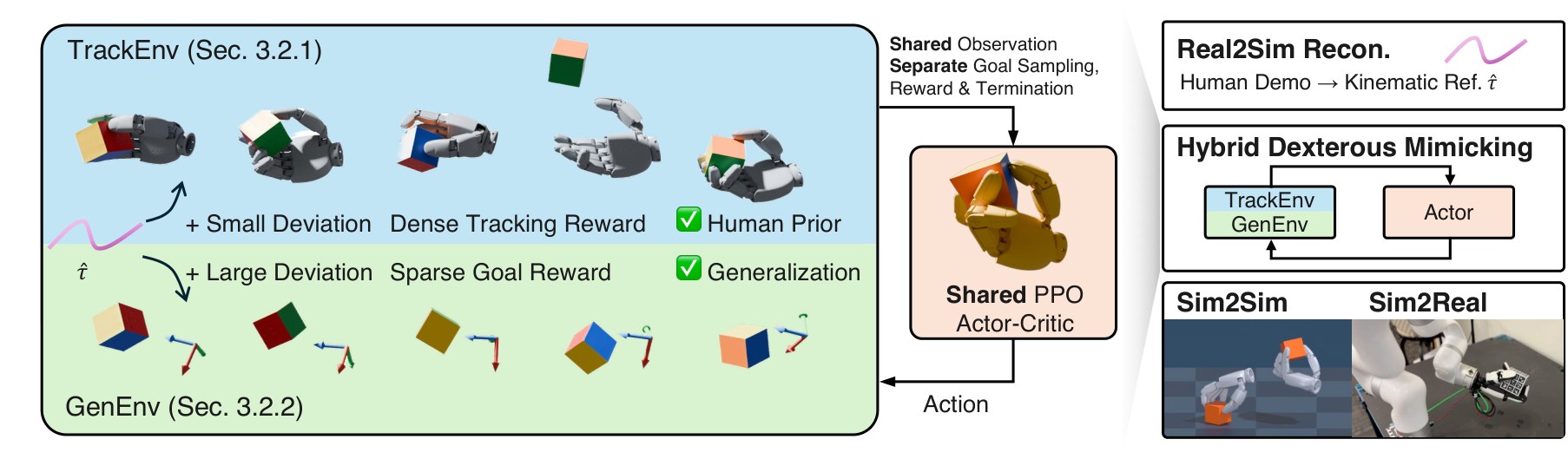
Dexterous multi-finger hands hold promise to unlock diverse skills like functional grasps, in-hand reorientation, and dynamic handover that the human-designed world assumes, yet existing learning recipes force a trade-off. Goal-reaching reinforcement learning generalizes to arbitrary object poses but, lacking any human prior, converges to unnatural and unreliable finger strategies; motion tracking reproduces human-like behavior from a single clip but cannot deviate from it. We present AdaDex, a goal-conditioned RL framework that turns a single hand-object trajectory of a few seconds—from mocap data or HOI reconstruction from in-the-wild RGB(D) video—into an adaptable dexterous skill. At the core of AdaDex is Hybrid Dexterous Mimicking: a shared policy is trained on two populations of massively parallel environments: motion tracking environments trained with dense motion tracking objective, which instill the human prior from human motion; and generalization environments with noised initial states and goals and a sparse object-success reward, which force the skill to work far off the reference. From seconds of human motion per skill, the resulting policies can learn diverse adaptable dexterous skills, such as functional grasping, object reposing, in-hand reorientation with finger gaiting, and dynamic behaviors like throw-and-catch. Our method outperforms baselines in terms of generalization and functionality, and we demonstrate transfer across simulators and to the real world.
AdaDex learns adaptable dexterous skills from seconds of human motion from mocap or in-the-wild videos, drives downstream tasks from new goal sequences, and transfers across robot hands.
\Skills
AdaDex learns adaptable dexterous \skills from seconds of human motion.
Coding agents (e.g., Codex w/ GPT-6 Astra) generate plans as sequences
of wrist and object pose waypoints for these \skills to execute in downstream tasks.
Click “View examples” on a skill card to see its videos below. Choose another card to explore different examples.
In-hand rolling and spinning with finger gaiting.
Dynamic throw-and-catch, and picking up and reorienting a cube in hand.
Picks up the marker, reorients it in hand into a writing grasp, then writes by following waypoints.
Tossing an object with a frying pan.
Functional hammer grasp striking new targets.
Grasp, lift, and tilt a mug to pour into a container.
Sweeping objects into a bin with a hand-held brush.
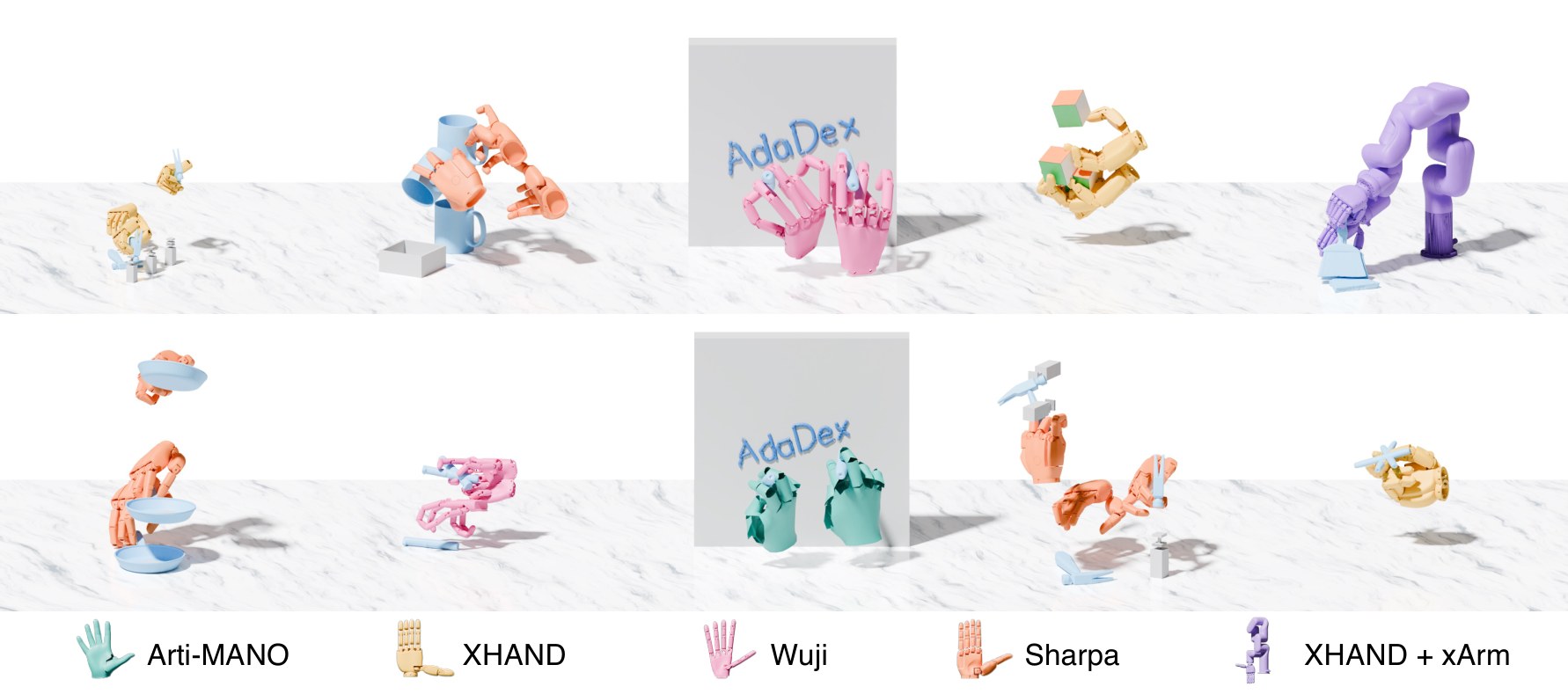
Human references are retargeted to different dexterous hands and learned without changing the method.
Click “View examples” on a hand card to see its videos below. Choose another card to explore different examples.
Tracking and goal reaching with ArtiMANO.
Tracking and goal reaching with XHand.
Tracking and goal reaching with Sharpa.
Tracking and goal reaching with Wuji.
A few seconds of casual RGB-D video become a simulation-ready hand-object reference, which AdaDex turns into an adaptable skill. Here, in-hand reorientation of a cube.
Left: reconstructed reference (goal object pose and wrist frame) · Right: AdaDex rollout
HOI reconstruction from the same casual RGB-D video with our pipeline, Do-As-I-Do, and EgoInfinity. We achieve better reconstruction quality and less runtime.
Motion tracking and goal reaching are the same goal-conditioned problem: both ask a policy to bring the object and wrist to a target pose, and differ only in where the goal comes from and how progress is rewarded. Hybrid Dexterous Mimicking trains one shared policy across two populations of massively parallel environments.
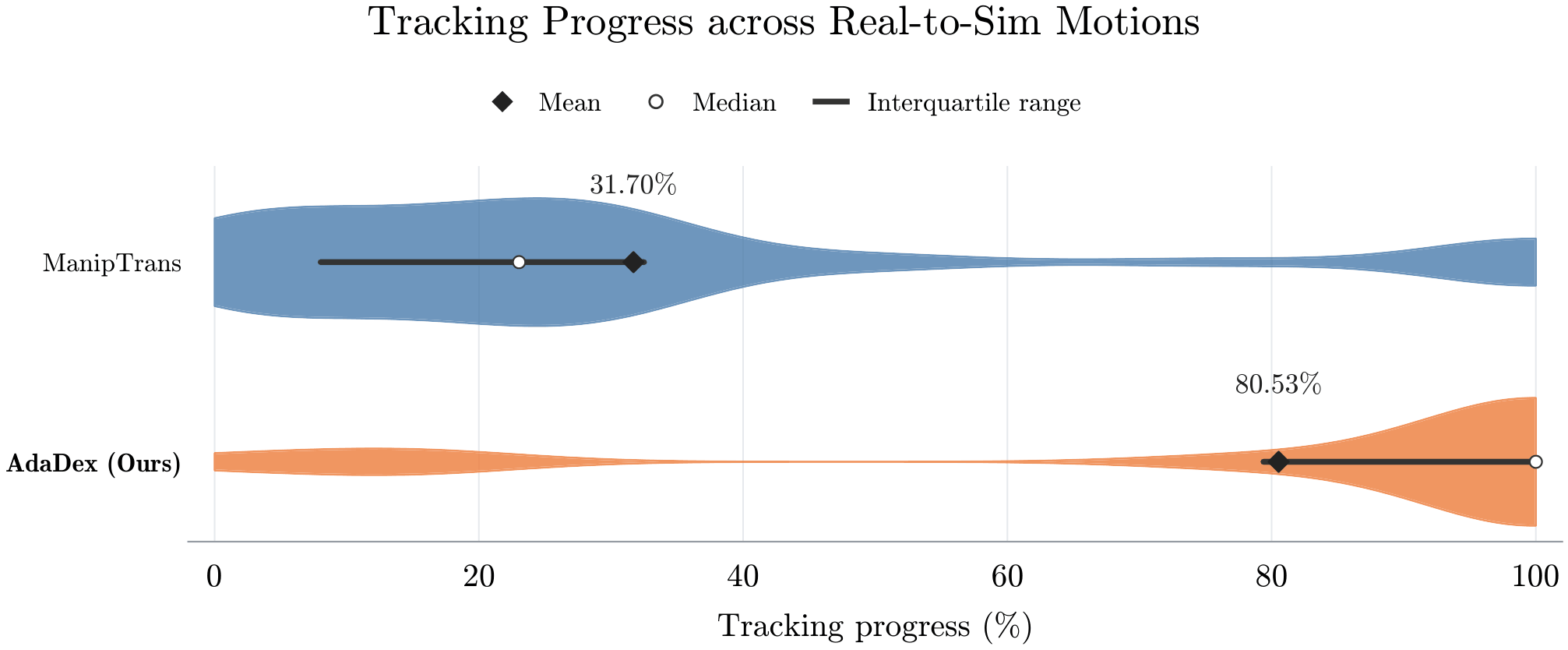
We benchmark on 12 GRAB sequences. Each policy is trained on only one motion per object and evaluated on that motion, on two similar but unseen motions, and on randomly generated goals. Below, the motion tracking baseline ManipTrans and the goal-reaching baseline SimToolReal are compared against AdaDex on all 36 benchmark motions: pick a motion to see the rollouts side by side with the human reference.
| Method | Progress (%) ↑ | Obj. pos. err. (cm) ↓ | Obj. rot. err. (°) ↓ | Wrist pos. err. (cm) ↓ | Wrist rot. err. (°) ↓ |
|---|---|---|---|---|---|
| Setting (i): seen (trained) motions | |||||
| ManipTrans | 35.20 ± 29.71 | 13.69 ± 16.11 | 41.61 ± 40.97 | 45.55 ± 65.28 | 55.22 ± 44.03 |
| SimToolReal | 9.72 ± 5.44 | 22.15 ± 18.32 | 53.56 ± 26.77 | 21.43 ± 9.79 | 65.30 ± 21.25 |
| w/o TrackEnv | 8.45 ± 4.98 | 34.10 ± 20.38 | 76.64 ± 31.72 | 3.65 ± 1.81 | 42.52 ± 25.23 |
| w/o GenEnv | 97.47 ± 8.40 | 0.62 ± 0.29 | 2.24 ± 0.79 | 2.76 ± 0.51 | 8.16 ± 4.73 |
| AdaDex | 96.74 ± 6.21 | 0.72 ± 0.32 | 4.16 ± 1.19 | 2.82 ± 0.61 | 11.45 ± 5.26 |
| Setting (ii): similar but unseen motions | |||||
| ManipTrans | 7.28 ± 6.57 | 37.95 ± 20.67 | 88.49 ± 26.81 | 256.50 ± 199.19 | 114.53 ± 21.40 |
| SimToolReal | 13.68 ± 17.88 | 19.80 ± 16.20 | 50.45 ± 25.85 | 24.34 ± 10.44 | 93.52 ± 33.78 |
| w/o TrackEnv | 9.62 ± 17.71 | 25.77 ± 16.92 | 63.15 ± 35.06 | 14.24 ± 8.11 | 79.26 ± 38.84 |
| w/o GenEnv | 31.75 ± 31.23 | 23.25 ± 22.82 | 52.13 ± 38.84 | 31.13 ± 23.28 | 87.91 ± 33.98 |
| AdaDex | 80.02 ± 26.01 | 6.07 ± 7.60 | 15.83 ± 12.93 | 14.32 ± 7.62 | 72.68 ± 44.90 |
Best in bold, second best underlined. Progress is the fraction of the clip tracked before the object deviates by more than 5 cm or 20°.
| Method | Progress (%) ↑ | SR (%) ↑ |
|---|---|---|
| ManipTrans | 1.72 ± 2.27 | 0.00 ± 0.00 |
| SimToolReal | 44.60 ± 31.59 | 31.71 ± 32.56 |
| w/o TrackEnv | 4.34 ± 7.38 | 1.43 ± 3.58 |
| w/o GenEnv | 14.53 ± 9.22 | 0.52 ± 1.03 |
| AdaDex | 51.80 ± 21.80 | 27.08 ± 17.41 |
Each trial attempts 10 consecutive procedural object goals. Progress is the percentage of goals reached; SR is the percentage of rollouts reaching all 10.
Here, we demonstrate the transfer of our policies across simulators and to the real world.
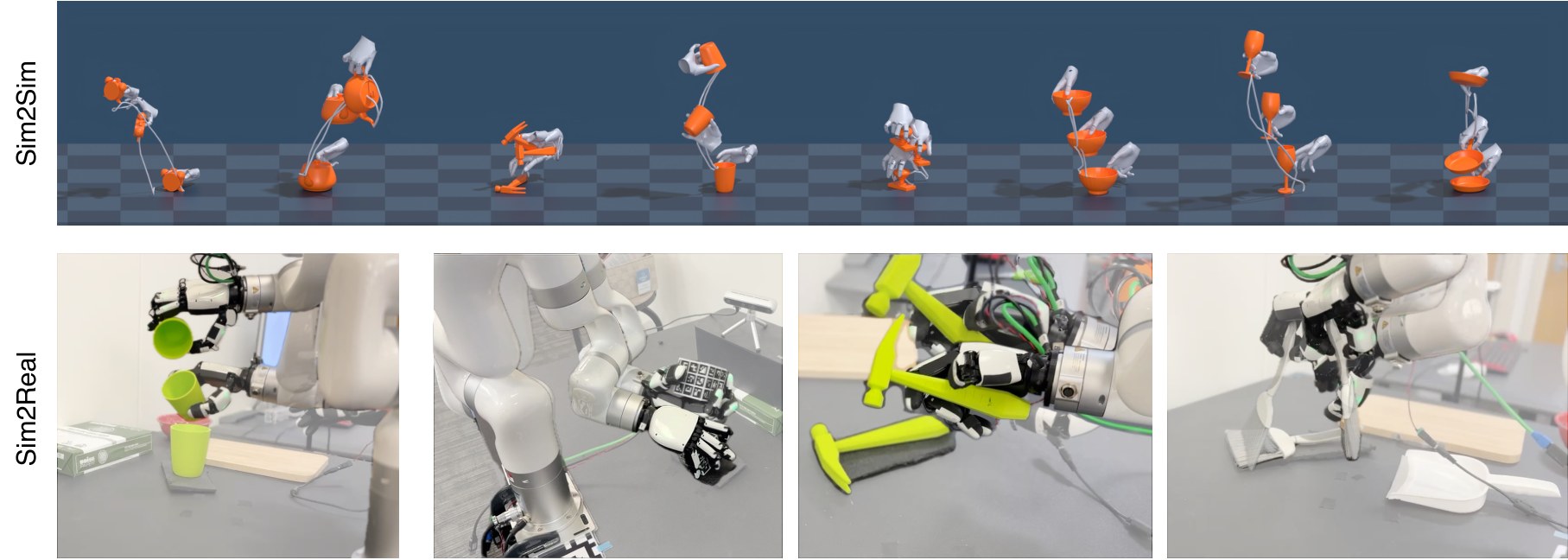
The same policy on each GRAB benchmark motion, rolled out in Isaac Gym and transferred to MuJoCo, zero-shot and closed-loop, without retraining.
A simulated rollout with an XHand mounted on an xArm, controlled by the same goal interface.
Open-loop and closed-loop real-world rollouts: the joint targets generated by the policy are directly passed to the real arm-hand system at 1x speed (30 Hz), preserving real-time dynamics.
Videos played in 1x. Pick a rollout below.